|
|
|
Custom Billet Manifolds |
|
****JavaScript based drop down DHTML menu generated by NavStudio. (OpenCube Inc. - http://www.opencube.com)****
|
|
|
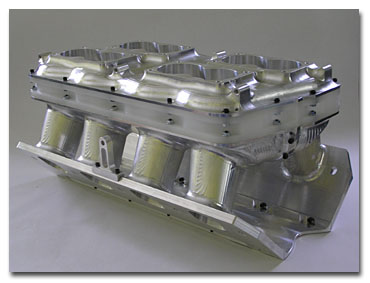 |
Billet bolt-together, DRCE-II with Split Dominators |
|
Billet Manifolds:
Complete billet manifolds are available for engine builders who want several identical manifolds. The extensive design and CNC programming resources consumed by this method can only be recovered by a limited production run of several manifolds with minimal or no changes. This is a good fit for multi-car teams or race engine leasing shops. The main manifold components are machined from 6061 or 7050 aircraft aluminum plate. Assorted HDPE plastic spacers are also included for plenum volume tuning. All of the components are doweled and bolted together using #10 socket head cap screws. There is NO welding or epoxy used in this type of manifold. This allows for precise repeatability from manifold-to-manifold and engine-to-engine. The quality and performance never disappoints. They are guaranteed to fit with only minor port matching required (0.02 maximum). In order to protect the particular plenum details of my customers internal R&D, we can only show partial pictures of this type of manifold. |
|
|
|
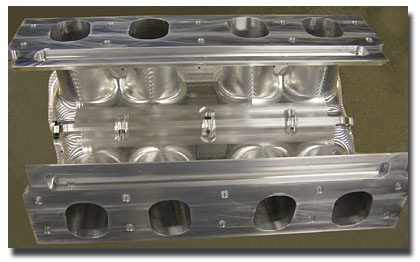
Bottom view of runner
assembly with no valley tray installed.
A complete manifold weighs just over 20 pounds, but it starts as over 300 pounds of aluminum billet. |
|
|
|
|
|
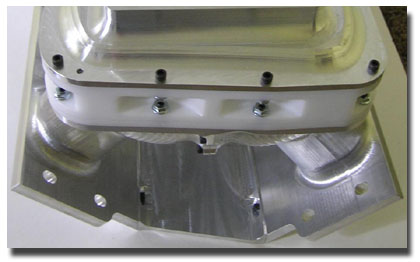
Front view, showing bolt-in
valley tray, contoured billet aluminum top, plastic volume-tuning
spacer, and double-flanged vibration isolation plastic spacer.
The top bolts are separate from the base bolts, thus reducing vibrations transmitted to the carburetors through the top fasteners. Most sheet metal manifolds use wood or rubber isolator spacers, but the steel bolts still transmit harmonics. Other features and benefits include: |
|
|
|
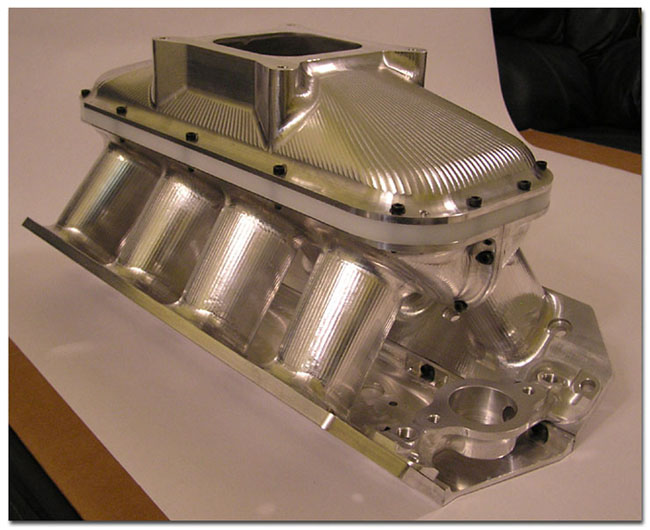
Billet SB2 with removable water
neck. |
|
|
|
|
|
Site design by Drag Strip Girl Designs |
Copyright SRM |
All logos and images are reserved |